
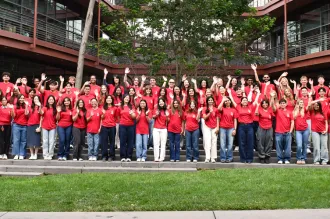
Apply for the 2027 Stanford Sapp Family CS Bio-X Undergraduate Summer Research Program!
October 16, 2026
Applications for the 2027 Stanford Sapp Family CS Bio-X Undergraduate Summer Research Program are due Tuesday, January 12, 2027, at 8:00am PST!
October 16, 2026
Applications for the 2027 Stanford Sapp Family CS Bio-X Undergraduate Summer Research Program are due Tuesday, January 12, 2027, at 8:00am PST!
October 7, 2026 - Stanford Medicine News
A study, from Stanford Bio-X affiliated faculty members and Clark Center resident faculty members Justin Sonnenburg and Benjamin Good, Stanford Bio-X affiliated faculty member David Relman, and co-lead authors Stanford Bio-X Fellow Zhiru Liu, Dr. Matthew Carter, and Dr. Matthew Olm, of the microbiome of groups in Africa and South America indicates that diverse gut microbes joined us as we migrated out of Africa — a diversity that is lost among industrialized peoples.
October 5, 2026 - Stanford Report
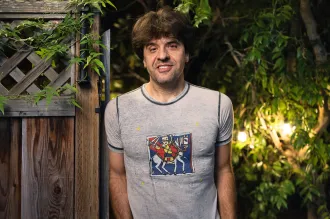
The professor of bioengineering and of psychiatry and behavioral sciences – a Stanford Bio-X affiliated faculty member and Clark Center building resident faculty member – shares the prize with two other researchers for their work in optogenetics.
September 28, 2026 - Cell
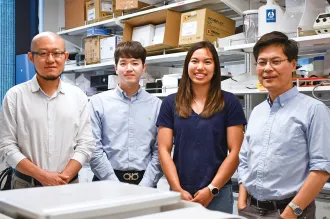
Stanford Bio-X affiliated faculty members Michael Lin, Guosong Hong, and Hanlee Ji, with co-authors Stanford Bio-X Fellow Marigold Malinao, Stanford Bio-X Fellow Sa Cai, and Stanford Bio-X/Novo Nordisk Foundation Visiting Scholar Michael Westberg, with first author Dr. Daesun Song, have demonstrated successful gene editing in the targeted skeletal muscle and brain regions of mice using adeno-associated virus (AAV)-transduced psCas12f and focused ultrasound (FUS) – a completely noninvasive method for localized gene editing in vivo. This work was partially supported by a Stanford Bio-X Seed Grant.
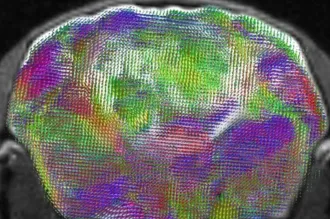
September 16, 2026 - Stanford Medicine News
The ability to study brain disorders that arise before birth has taken a leap forward as Stanford Medicine researchers Stanford Bio-X affiliated faculty members and Clark Center building resident faculty members Sergiu Pașca, and Karl Deisseroth, Stanford Bio-X affiliated faculty members Hannes Vogel, Brian Wandell, and Julia Kaltschmidt, with co-lead authors Dr. Konstantin Kaganovsky, Stanford Bio-X affiliated faculty member Dr. Kevin W. Kelley, Dr. Tilo Gschwind, and Paul M. Harary, find a new way to grow human brain tissue outside of the human brain.
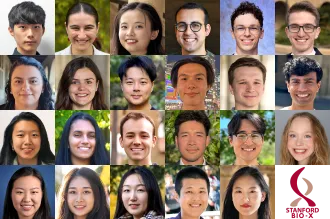
June 8, 2026
Stanford Bio-X is delighted to announce the 2026 cohort for the Stanford Bio-X PhD Graduate Student Fellowships.
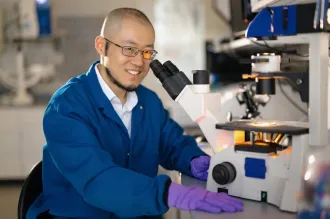
April 13th, 2026 - Stanford Report News
A new technique from Stanford Bio-X affiliated faculty members Guosong Hong, Jun Ding, Xiaoke Chen, and Michael Lin, with co-authors Stanford Bio-X Bowes Fellow Marigold Malinao and Stanford Bio-X Fellow Nicholas Rommelfanger and lead author Dr. Shan Jiang - using ultrasound waves to activate light-emitting nanoparticles - could be used to manipulate cell signals or facilitate light-based medical treatments in the future. The work was partially supported by a 2022 Stanford Bio-X Interdisciplinary Initiatives Program Seed Grant titled: Label-free and transgene-free detection of neurotransmitters in the enteric nervous system with ultraflexible intraplexus electronics and a 2020 Stanford Bio-X Interdisciplinary Initiatives Program Seed Grant titled: Ultrasound-controlled in vivo gene editing via photoswitchable CRISPR-Cas9.
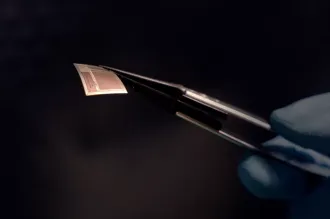
December 8, 2025
Andreas Tolias, a Professor in the Stanford Department of Ophthalmology at the Byers Eye Institute, as well as a Stanford Bio-X affiliated faculty member and Clark Center resident faculty member, is a senior author on the publication in Nature Electronics. Fabricated as a single chip, the new implant is orders of magnitude faster and smaller than today’s state-of-the-art brain-computer interfaces, offering an opportunity for more efficacious treatment of a number of neurological conditions.
September 17, 2025 - Stanford Report News
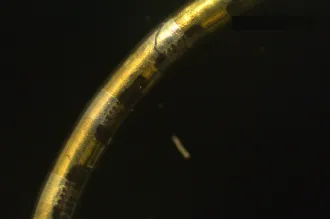
Developed by Stanford Bio-X affiliated faculty members Zhenan Bao, James Dunn, Julia Kaltschmidt, and Xiaoke Chen, with co-authors Stanford Bio-X Travel Award recipients Alex Abramson, Ryan Hamnett, Samuel Root, Weilai Yu, Yuanwen Jiang, Jinxing Li, and Weichen Wang, and co-lead authors Stanford Bio-X Travel Award recipient Muhammad Khatib, Stanford Bio-X PhD Fellow Eric Zhao, and Shiyuan Wei, NeuroString is a hair-thin multichannel biosensor and stimulator with promising potential applications in drug delivery, nerve stimulation, smart fabrics, and more. The work was initially launched by a 2018 Stanford Bio-X Interdisciplinary Initiatives Program Seed Grant titled: Closed-loop neurochemical sensing and modulation system for treating psychiatric disorders.